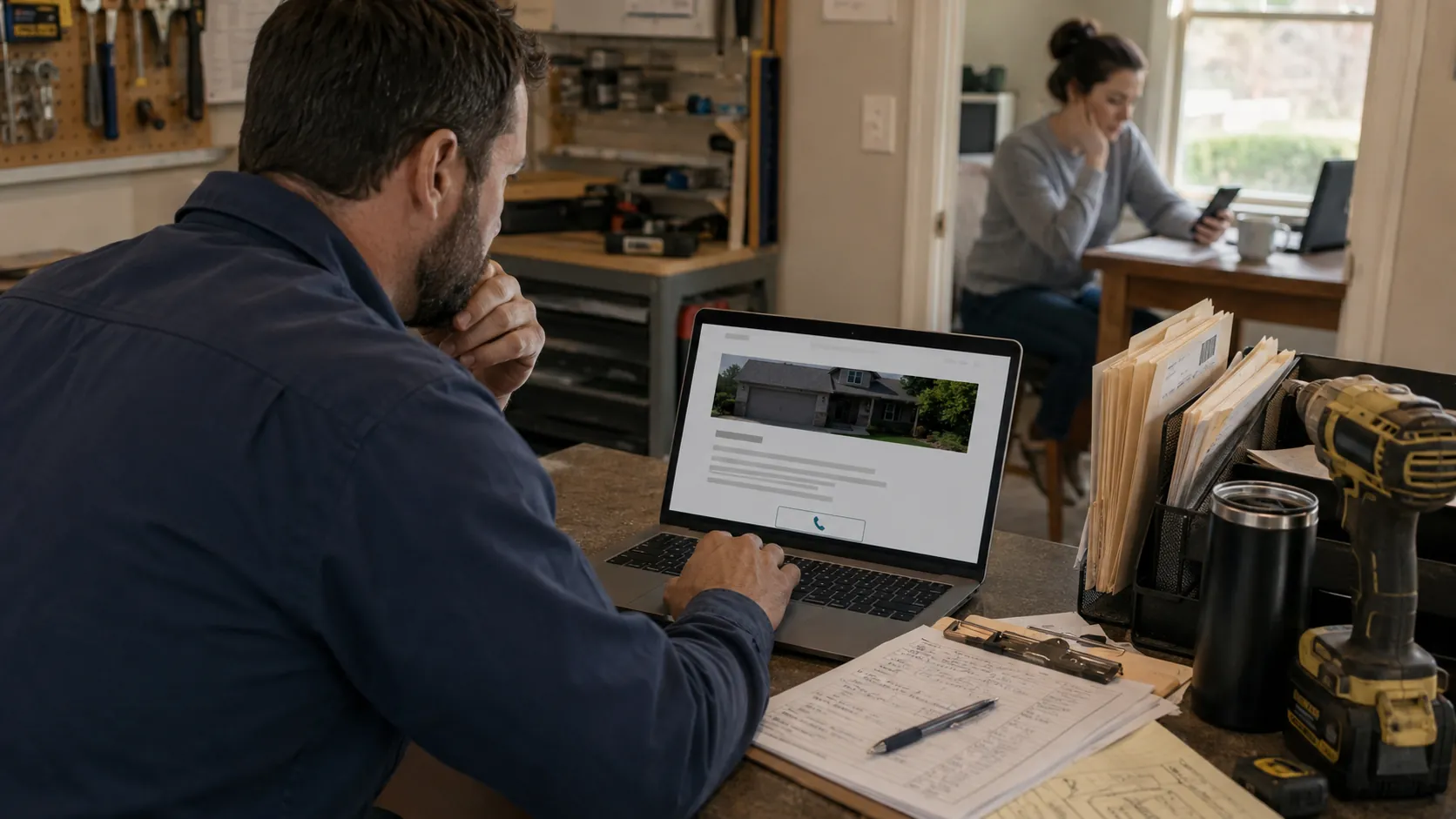
Thin service pages do not just make SEO harder.
They make a good business look like every other business in town.
That is the bigger cost.
When a homeowner lands on a service page and sees 200 words of vague promises, a stock photo, and a button that says Call Now, they still do not know enough to trust you. They cannot tell what kind of jobs you actually want, how you work, what makes your crew different, or whether you are the right fit.
So they do what people always do when the page gives them nothing useful.
They back out. They compare on price. Or they call the shop whose page feels more specific and more real.
Thin Service Pages Are Not Neutral
A lot of owners treat thin pages like a temporary problem.
“We’ll flesh those out later.” “At least the page exists.” “We just need a page for each service.”
I get why that happens. Service pages are not glamorous work. But a weak page is not sitting there harmlessly. It is actively flattening the business.
Google’s current people-first guidance asks whether a page gives a substantial, complete description, adds original value, and actually helps the reader achieve their goal. That is a useful standard even if you forget rankings for a second — because it matches how real people read service pages.
They are not looking for filler. They are looking for proof.
If the page reads like it was built to catch a keyword instead of help a customer make a decision, it usually feels that way.
The Copy-Paste Service Area Problem
Here is something I see constantly when I audit service pages for small businesses.
A company serves their home market well. Then they decide to expand — three or four towns within ten or fifteen miles. So they build a page for each one. Same copy, different city name swapped into the header. Maybe the URL changes. That is it.
Google sees through it immediately. Those pages are functionally identical. They do not rank. They do not show up in the map pack. And increasingly, they do not appear in AI search results at all — because AI search pulls from pages that demonstrate actual knowledge of a place, not pages that name-drop it.
The problem is not that you built service area pages. The problem is that copy-pasted pages tell Google you are just fishing for terms, not actually serving those communities. Google has specific spam guidance around this — pages built mainly to catch similar searches without giving the visitor added value are not a smart long-term bet, and that guidance has teeth now in a way it did not two or three years ago.
Each service area page needs to be its own thing. What neighborhoods do you actually work in? What are the common job types in that market? Are there permit quirks, soil conditions, code differences, or infrastructure characteristics specific to that area that affect the work? Do you have any history there — jobs completed, customers served, local references? That is the kind of detail that makes a page useful to a real visitor and credible to a search engine. One without the other does not get you far.
Your Website Is Where People Verify You
This part matters more now, not less.
DreamHost’s 2026 Local Business Trust Index found that 69% of consumers say a website is essential for a local business to be credible. For contractors and home service providers specifically, 66% said they are more likely to hire a company with a website. It also found that 58% often or always check the website to verify what they saw somewhere else.
That tracks.
People might find you on Google, Maps, Facebook, a referral thread, or even AI search. But when the job matters, they still go to the website to make sure you look real.
And Clutch’s 2025 trust survey says that decision happens fast. It reported that 83% of consumers judge a website’s credibility in under 20 seconds, and 45% say the first impression shapes whether they keep engaging.
So if your service page is thin, generic, or a city-swapped copy of three other pages, you are not just missing SEO content. You are failing the verification step.
What Thin Service Pages Usually Leave Out
Most thin pages miss the exact details that separate a solid local operator from a generic listing.
They do not explain the real job.
A plumbing page says “we handle water heater services” but never tells the customer whether you repair, replace, install tankless units, handle code upgrades, or help them decide when replacement makes more sense than patching. An HVAC page says “maintenance keeps your system running efficiently” but never shows what a maintenance visit actually includes, who it is best for, or what you typically find when you get there. A roofing page says “we provide reliable roof repair” but never explains what counts as a repair call, how quickly you can inspect, or when you tell a homeowner the roof is too far gone to patch.
Those details matter. They help the customer qualify themselves — the right jobs call, the wrong jobs self-select out. And they make the business sound like it has actually done the work before.
Thin pages also usually hide the trust signals people are looking for:
- specific service scope
- service area clarity
- real photos or grounded proof
- process details
- timing expectations
- common questions
- a next step that feels clear instead of pushy
Without those things, the business starts to sound interchangeable. Good company, generic page, lost advantage.
The Mobile Version Cannot Be the Skinny Version
This is where a lot of service sites quietly hurt themselves.
Google uses the mobile version of a site’s content for indexing and ranking. If the mobile page has less content than the desktop page, expect traffic loss — Google is working from less information.
Most local service traffic is happening on a phone. If the mobile page strips out the useful details, collapses the proof, buries the CTA, or turns the whole page into a few vague lines and a stock photo, the visitor is left with even less reason to trust you.
The fix is to keep the substance and present it cleanly. Use accordions if you need to. Tighten the layout. Shorten the paragraphs. But do not remove the information that helps someone decide.
What a Strong Service Page Actually Needs
A strong service page usually does five things.
1. It names the real job
Not just the service label. It explains what the customer is dealing with, what kind of work you do under that service, and what situations make someone a fit to call.
2. It shows how you work
People do not just want to know that you offer the service. They want to know what happens next. Do you inspect first? Can you give options? Do you handle emergency calls? Do you serve certain towns or zip codes? What does the appointment actually look like? That specificity lowers friction in a way a headline never will.
3. It proves you are specific, not generic
Local photos, grounded examples, before-and-after context, review snippets, crew details, warranty language — these do real work. Not because every page needs to be fancy. Because vague pages feel risky, and a page that knows the territory feels like someone who has actually done this job.
4. It answers the questions that normally stall the call
What does this service include? How fast can you usually get out? Do you work on this equipment or problem type? When is repair still worth it? If the page answers none of that, it is leaving too much of the decision until the phone call — and a lot of those calls never happen.
5. It gives the visitor a clean next move
Call. Book. Send photos. Request an estimate. Check service area. Whatever the right next step is, make it obvious. A surprising number of service pages make the customer do detective work at the exact moment they were ready to move.
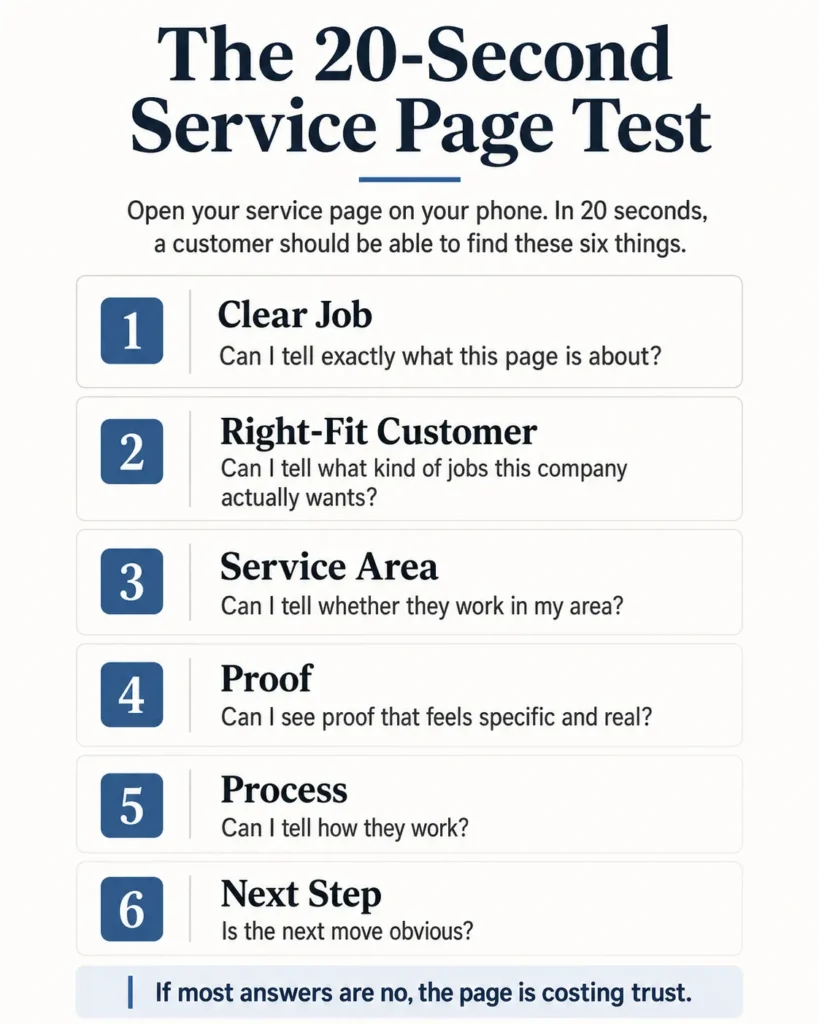
Run the 20-Second Test
If you want to know whether thin service pages are making your business look generic, do not start with a content calendar.
Start with your five most important service pages on a phone.
Give yourself 20 seconds on each one and ask:
- Can I tell exactly what this service page is about?
- Can I tell what kind of jobs this company actually wants?
- Can I see what makes them different from the next three businesses?
- Can I tell whether they work in my area?
- Can I see proof that feels specific and real?
- Is the next step obvious?
If the answer is mostly no, the page is not just thin. It is costing trust. And if you have service area pages that are copies of each other with the city name swapped, that is not a content problem — it is a credibility problem, and Google is treating it that way.
Final Word
A thin service page does not make a bad business look bad.
Usually that part was already handled.
What it does is make a good business look ordinary.
When your page is vague, the customer cannot see the difference between your company and the cheaper, sloppier, less organized shop down the road. So the decision gets pushed onto price, star rating, or whoever answered first. That is a rough place to compete from if the business is actually better than that.
Service pages should not exist just to say you offer something.
They should make the right customer think, “These are my people.”