Most estimates don’t go cold because your price was too high.
They go cold because the homeowner got the quote, then got silence.
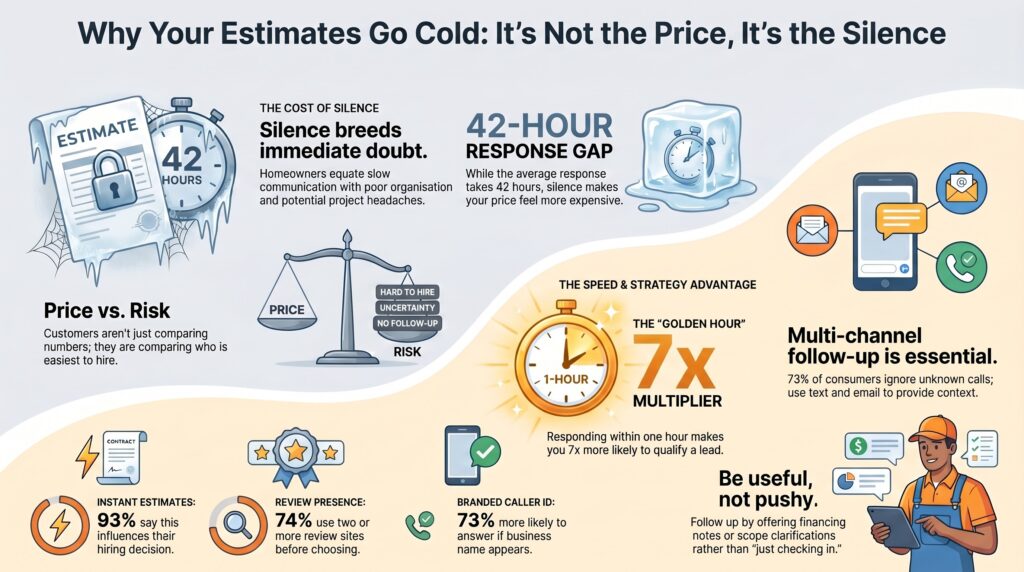
Silence breeds doubt fast. The homeowner starts wondering whether you’re organized, whether the scope is actually clear, whether the job’s going to be smooth or a headache. Once that doubt shows up, your number starts feeling expensive even when it’s fair.
That’s the whole game.
The estimate isn’t the end of the sale. It’s the moment the customer starts judging how easy you are to hire.
Why estimates go cold isn’t usually about price
Price is the clean story. It gives you something to point at.
“We lost it on price.”
Sometimes that’s true. A lot of the time it’s cover for a weaker problem: the estimate went out, and follow-up got treated like an optional extra.
I coached a contractor a while back who’d send out an estimate and then wait a full 24 hours before texting the customer. By the time he checked in, the homeowner had already pulled two or three more quotes. There was nothing left to compete on but dollars, and he was racing the cheapest guy in town to the bottom of his own pricing.
If he’d confirmed the customer got the estimate inside 20 minutes, then followed up later that same day with something useful — a financing note, a clarification on scope, a quick answer to the question he knew was coming — he would’ve been the only contractor still actually in the conversation by the time those other quotes hit the inbox. Price wouldn’t have been the only thing left to compare.
The homeowner isn’t just comparing numbers, they’re comparing risk. Who got back to them first, who made the scope easy to understand, who answered the obvious next question before they had to ask it. That stuff matters more than most owners want to admit, because it’s less comfortable to fix.
Estimate follow-up speed changes the sale
This isn’t theory.
A Harvard Business School working paper, later covered by Harvard Business Review, found that companies trying to contact a lead within one hour were nearly 7x more likely to qualify that lead than companies that waited longer. The average response time in that audit was 42 hours. Twenty-three percent never responded at all.
Forty-two hours.
That’s an eternity when somebody needs a roof checked after a storm, an AC replaced before the weekend, or a landscaping bid before they commit the budget.
Google’s Local Services Ads guidance points the same direction. Messaging response time can show up in your ads, and consistently fast response can help ranking and lead flow. Housecall Pro’s 2025 homeowner report puts numbers on it: 93% of homeowners say instant estimates influence hiring, and 97% say speed and pricing both matter in the choice.
So speed isn’t “nice customer service” anymore. It’s part of the offer.
One missed callback can kill your estimate follow-up
Here’s a common one.
You send the estimate. You call once from a cell phone. Maybe twice. You leave a voicemail. Then you tell yourself they must have gone with somebody else.
A lot of people are trained to ignore unknown numbers. TransUnion’s 2024 consumer research found a large share of consumers avoid those calls, and 73% said they’d be more likely to answer if the business name and logo showed up on screen.
So when somebody tells me, “we followed up,” I want to know what that actually means. Was there a text? A short email recap? Did the customer have any idea who was calling and why, and a low-friction way to reply?
One or two mystery-number calls aren’t a follow-up system. That’s wishful thinking with a call log attached.
What homeowners judge after you send the quote
The quote isn’t sitting alone in the customer’s inbox.
Your reviews are in the room with it. So is your response time, your review replies, and every small signal that says “easy to work with” or “probably going to be a pain.”
BrightLocal’s 2025 survey found 74% of consumers use two or more review sites before choosing a local business, and that consumers are less likely to hire a business that doesn’t respond to reviews.
Silence after the estimate doesn’t feel neutral. It stacks up with everything else they’re seeing: a slow reply, no review responses, a vague scope, a phone number that’s hard to reach. Now your price feels heavier than it really is.
The estimate that closes is the one that’s easier to buy
This shows up in normal, boring field situations all the time.
An HVAC company gets a furnace replacement request at 8:30 at night. One competitor sends the estimate the next day and waits. The other replies that night, texts the next morning, explains financing, and offers two install windows. Same neighborhood, same kind of job, probably not a giant spread in price. But one company feels easier to say yes to.
Roofing after a storm plays out the same way. So does landscaping, where two bids come in close and the winner is the one that included a clear scope summary, expected timing, and one useful note about drainage or plant survival. That estimate’s easier to trust because it’s easier to compare.
The estimate that closes is often the one that reduces the most uncertainty, not the one that shaves the most dollars.
Five estimate follow-up numbers to audit before buying more leads
If estimates keep going cold, check these:
- Average first response time to new estimate requests
- Percentage of estimate requests answered after hours
- Percentage of quotes followed up within 24 hours
- Average number of follow-up touches inside seven days
- Estimate-to-close rate by contact method
Then go one step further. Break out how much of your follow-up is phone-only versus phone-plus-text or phone-plus-email. If most of your quote follow-up still depends on unknown-number calls, there’s a decent chance you don’t have a lead problem first. You have a contact-method problem sitting right in the middle of your estimate process.
How to fix the silence after sending an estimate
Lowering your price is easy. Anybody can do that.
Fixing the estimate process is more honest work. You have to look at whether the scope was clear, whether somebody owned the next step, whether the customer had a clean path to reply, and whether your business felt solid after the quote went out.
That’s why estimates go cold. Price matters, but a lot of companies are still sending estimates like they’re paperwork, when the customer is judging the whole experience around them.
Fix the silence and you’ll close more of the work you’re already quoting.